The Challenge Initiative’s first quarterly bulletin uses actual data reported by local health systems – not projections – to track the fallout of the 2025 U.S. funding cuts and finds a model for recovery already working in some places.
The Challenge Initiative (TCI) – a global women’s health platform based at the William H. Gates Sr. Institute for Population and Reproductive Health at the Johns Hopkins Bloomberg School of Public Health – today published the first at-scale account of the impact of the 2025 U.S. foreign aid cuts on family planning using actual local government health records rather than statistical models.
The bulletin, titled “Holding the Line,” draws on monthly facility-level data from 214 TCI-supported locations across 13 countries in Africa and Asia. It finds that the pace of growth in the number of women using modern contraception has more than halved since the cuts began: from 1.86 million additional users a year in January 2025 to 844,000 a year as of June 2026.
When the United States dismantled the U.S. Agency for International Development (USAID) in the early months of 2025, it also disrupted the U.S.-supported survey systems that would normally measure the damage. The government-run data systems in TCI-supported locations kept reporting without interruption, giving researchers a rare, real-time view into the crisis as it has unfolded.
Key findings
- Seventy-seven of the 214 locations are now losing family planning users, up from 36 when the cuts began. Nearly two-thirds of those locations are in four countries: Kenya, Tanzania, Uganda and Senegal.
- Together, these 77 locations have lost an estimated 400,000 users a year, in areas home to 22.9 million women of reproductive age.
- A further 73 locations are still seeing gains, but at less than half their earlier pace. Together they were adding around 900,000 users a year when the cuts began and add around 400,000 today, forgoing close to half a million additional users a year.
- The damage is not universal. Locations in Nigeria and Côte d’Ivoire have grown faster since the cuts began than before them, evidence that government-owned, locally led programs can weather a sudden loss of external funding.
- An independent 2026 evaluation by Itad attributed meaningful gains in contraceptive use to TCI’s coaching model, with a positive return on investment in every geography studied.
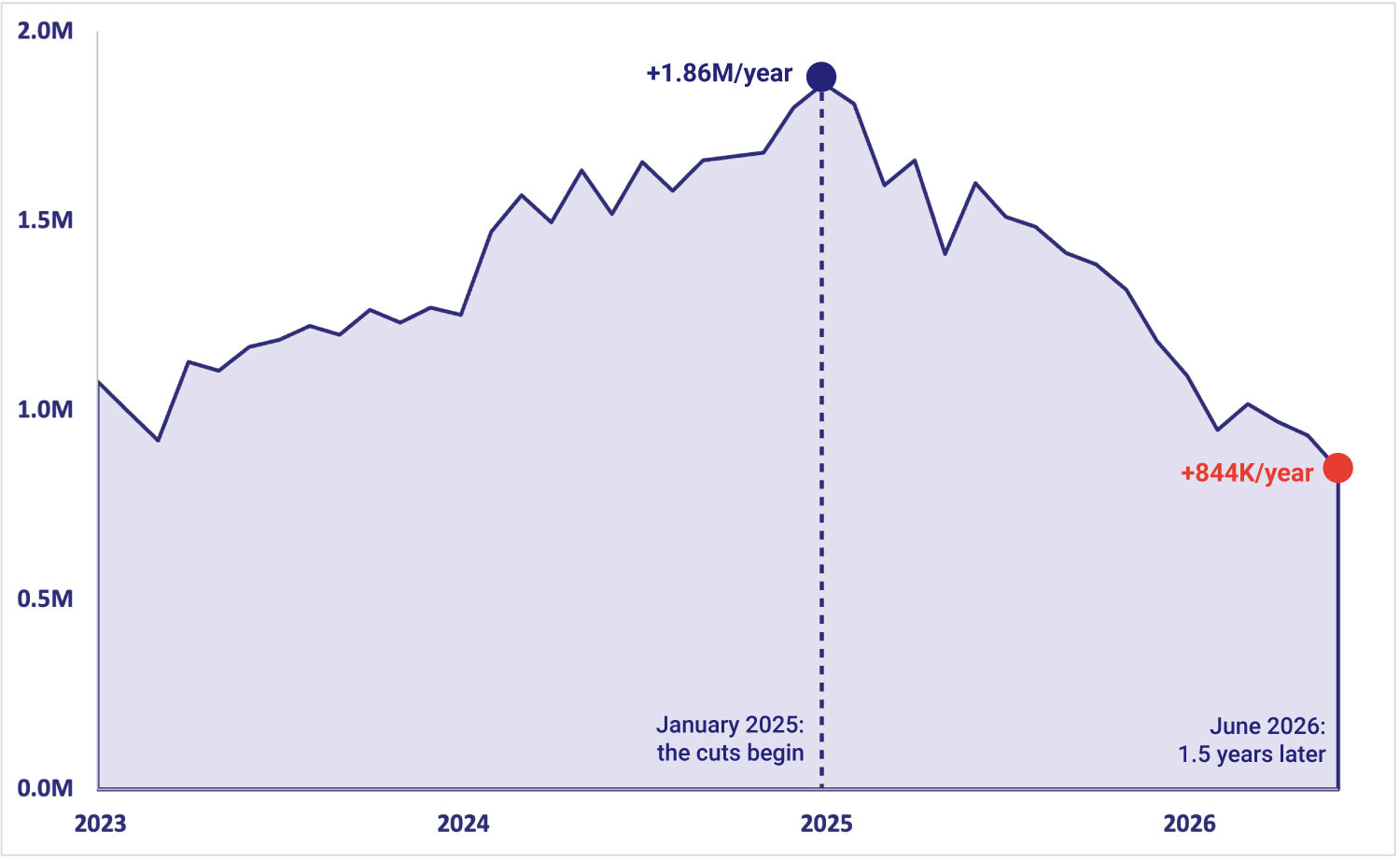
Users added over the trailing 12 months, all 214 locations, January 2023 to June 2026 (government HMIS, unsmoothed).
“Because TCI strengthens both health systems and staff capacity at the subnational level, we have a front-row seat to the real-world impact of these massive funding cuts on communities,” says Kojo Lokko, TCI’s Executive Director. “TCI has also helped local governments strengthen their own health management information systems. Because those systems report monthly from every health facility, we have access to data most others simply don’t.”
TCI is calling for a targeted, time-limited response rather than an appeal to rebuild what was lost. Donors and development finance institutions are being called on to fund a re-ignition and re-engagement push for the locations now losing ground – progress that can be verified monthly in the same government data behind the report. National and local governments are urged to protect their family planning budget lines and safeguard the resources they fought for before the cuts. Implementing partners are invited to leverage TCI’s coaching model, diagnostic tools, and other resources, which are open for replication.
About The Challenge Initiative
The Challenge Initiative (TCI) is a global women’s health platform based at the William H. Gates Sr. Institute for Population and Reproductive Health at the Johns Hopkins Bloomberg School of Public Health. For nearly a decade, TCI has worked with city and local governments across more than 214 locations in Africa and Asia, coaching them to run their own family planning and maternal, newborn, child health programs better with their own staff and budgets. TCI works with donors, the private sector, and development finance institutions to help countries and communities improve women’s health at scale.
The full “Holding the Line” bulletin along with an infographic with key findings (posted below) is available at tciurbanhealth.org.
Fullscreen Mode