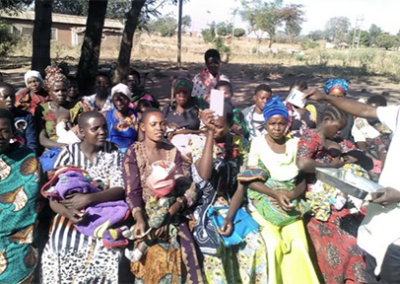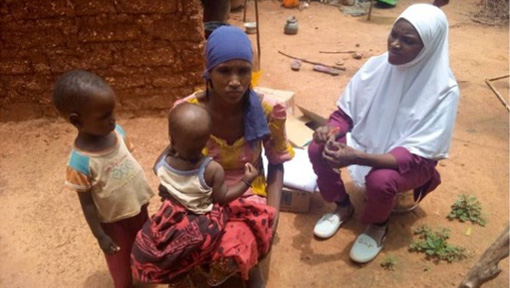
A service provider counseling a family in the So Haraja community.
In the remote village of So Haraja, nestled in Zika of Jigawa State, traditions run deep, and privacy is paramount – especially when it comes to family matters. Despite the growing need for family planning services, cultural norms often prevent women from seeking the care they need at public facilities. Many women rely on their husbands to advocate on their behalf, creating a significant barrier to accessing these essential services.
During a recent community sensitization session, Zambiya, a dedicated social mobilizer supported by The Challenge Initiative (TCI), encountered a group of men from So Haraja. They expressed interest in family planning but voiced serious concerns about confidentiality. Traditional outreach efforts – where women gathered in groups – did not align with their cultural values. They needed a solution that would respect their privacy while allowing their families to benefit from family planning services.
Recognizing the gravity of their concerns, Zambiya took the issue to the Health Promotion Officer (HPO), Reproductive Health (RH) Coordinator for Zika LGA, and the Director General of the Technical Support Lead (DG-TSL). Together, they devised an innovative solution: household outreach for family planning services. This approach ensured the utmost confidentiality while respecting the community’s cultural norms and expanding access to care.
On the designated day, Zambiya, the RH Coordinator, the LGA HPO, and service providers embarked on a discreet, house-to-house mobile outreach mission in So Haraja. The response was overwhelming – more than 70 women received family planning services, many for the first time. Most opted for long-acting reversible contraception (LARCs), underscoring the urgent need for these services in the community.
During one of these visits, the team met Liala, a mother whose story illustrated the depth of need within the village. Liala shared her distress about her 17-year-old daughter, Amriya, who has mental disabilities and had been repeatedly exploited, resulting in two pregnancies within just 15 months. Desperate to protect her daughter, Liala pleaded for help.
With Liala’s consent, the service providers discussed the best options for Amriya’s safety. Initially, Liala considered an intrauterine device (IUD) but learned that maintaining it required strict personal hygiene, which could be challenging for Amriya. Instead, the team recommended Jadelle, a long-acting implant that provides up to five years of reliable protection.
Relieved and grateful, Liala agreed to the implant, knowing it would provide her daughter with much-needed security. For the first time in a long while, she felt a sense of peace, knowing Amriya would be safe from unintended pregnancies. She expressed heartfelt gratitude to TCI and the healthcare team for their life-changing support.
This experience underscores the impact of TCI’s adaptable and culturally sensitive healthcare solutions. By offering confidential, household-based family planning services, TCI and the Zika health team reached women who might otherwise have remained without care. This innovative approach has transformed lives in So Haraja and set a precedent for reaching other underserved communities with strict cultural norms.
It is a powerful reminder that with empathy and flexibility, healthcare services can be tailored to respect community values while ensuring that every woman, regardless of her circumstances, has the right to make informed choices about her health and future.